Newsletter Block
This newsletter signup form needs a storage option. Edit the block and enter a storage location via the Storage tab.

Continously evolving since it first went online in 1996, ‘Engaging with the world’ presents Thomas Hylland Eriksen's writings, research and miscellaneous activities, such as music and podcasting. A social anthropologist by training, Eriksen reads, writes and talks in many genres about the contemporary world, what it means to be human and how you and I can make the world a slightly better place. Many of his writings about contemporary and timeless issues, ranging from Darwinian selection and information technology to the climate crisis and cultural diversity, are available on this site. The Norwegian-language subsite can be accessed here. This is never going to be a complete archive. More of a labyrinth, I guess.
After his passing, parts of Thomas’ legacy are kept here. News and texts will be published at irregular intervals. (Kari Spjeldnæs; kari.spjeldnaes@gmail.com)
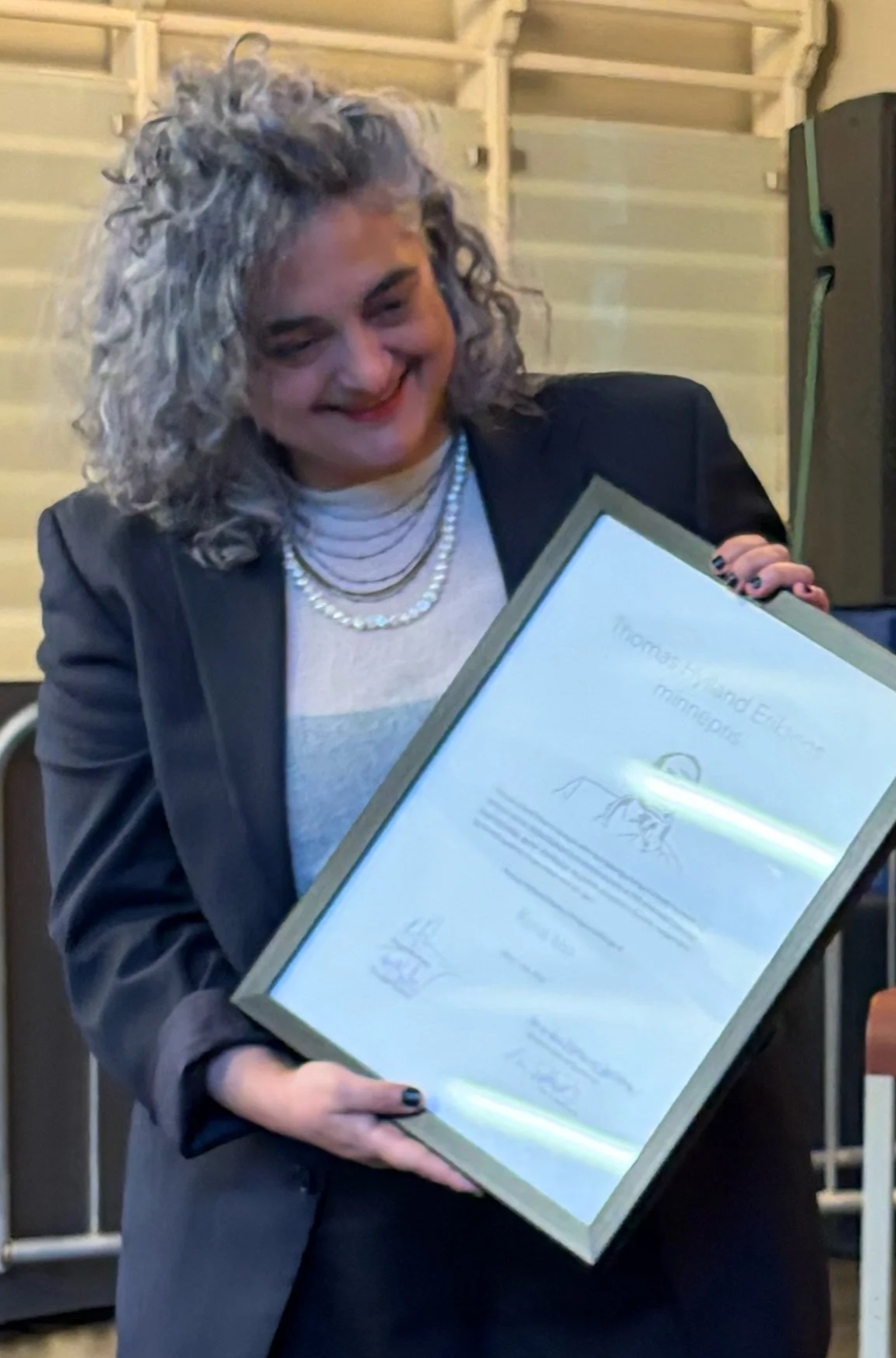
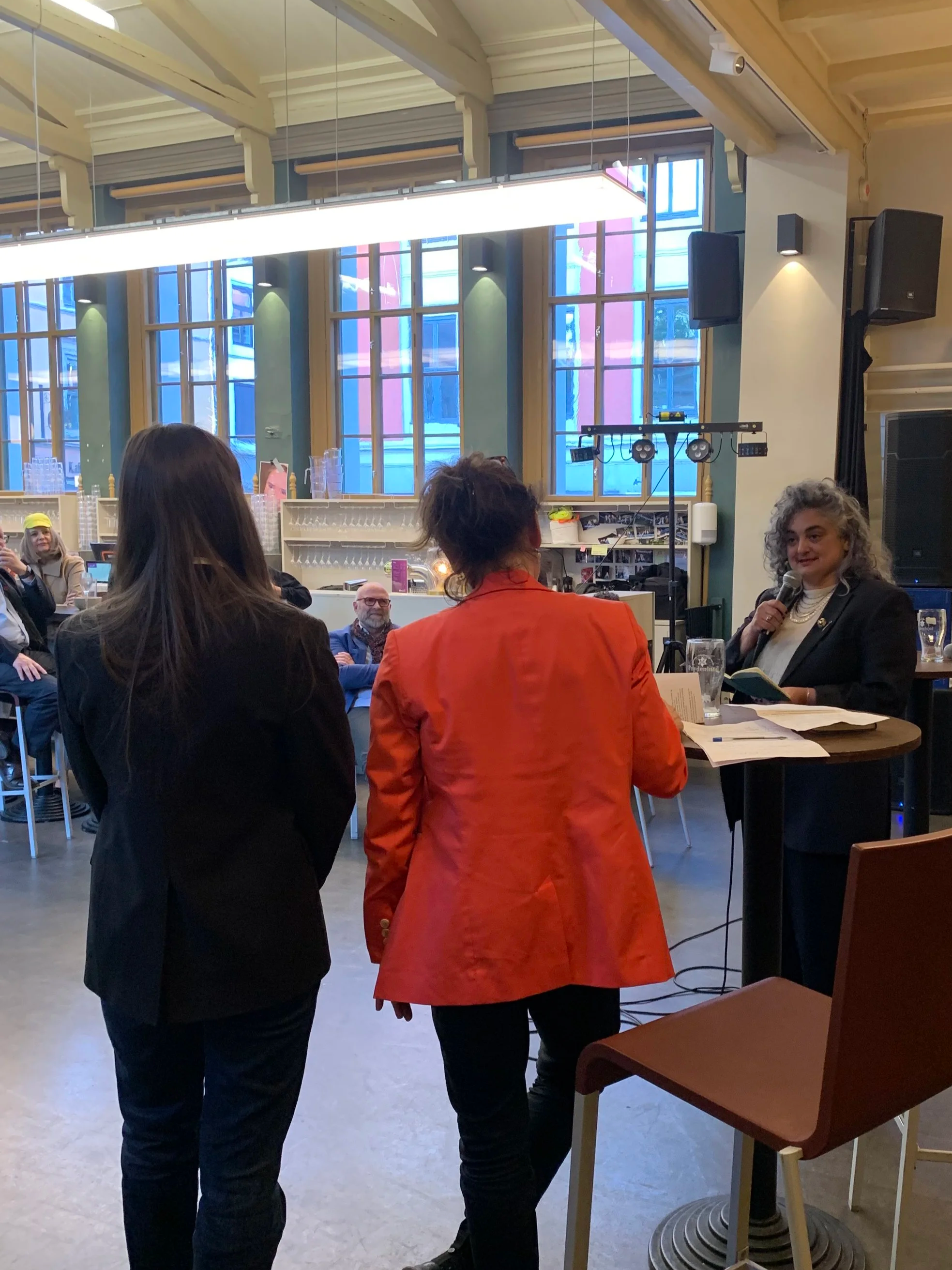
Following THE Dialogue at The University of Oslo May 7, 2026, Rana Issa was awarded the Thomas Hylland Eriksen Memorial Prize 2026. Rana Issa is a researcher, writer and curator. In 2015, she defended a dissertation on nineteenth-century Arabic Bible translations, which later appeared in book form as The Modern Arabic Bible (2023). In the book, she combines linguistics, philology, and cultural history to understand how different Bible translations negotiate the relationships among tradition, modernity, and colonialism. In the hands of English-speaking missionaries, the Bible became a tool for modernisation and cultural domination, while also contributing to the shift from Classical to Modern Arabic. The translations were, on the one hand, deeply locally inflected and rooted, and, on the other hand, part of a global circulation of ideas about humanity, society, politics, faith, and theology.
After completing her thesis, Rana Issa took a position at the American University of Beirut to develop a new translation program. She thus returned to the city where she grew up, as the child of Palestinian refugees. In 2020, when she no longer regarded the city as a good and safe home for her children, she moved back to Oslo. She continued the work of building Masahat – The Association for Arab Art and Culture in Exile in Oslo, which she had helped found before returning to Beirut. Over time, she assumed the role of artistic director. At the same time, she established herself as a writer, artist and public intellectual for a second time, now working in a language that is not her mother tongue.
In 2025, her first book in Norwegian was published, Tung tids tale, which is at once a deeply personal memoir, a history of the Palestinian diaspora and life in the Palestinian refugee camps in Lebanon, a meditation on women’s role in a male-dominated postcolonial society, and a series of philological-essayistic reflections on language, the body and gender. Although both the book and its author challenged the Norwegian public in several ways, culturally and intellectually, it was met with glowing reviews in the press and among readers and has laid the foundation for Rana’s second career in Norway – not as a researcher this time, but as a writer. For her, however, the two are not so different, but part of a lifelong project to understand what it means to live, write and love in exile. Tung tids tale is published in Arabic Spring 2026.
Through her work, Rana Issa brings the personal to life and makes the political personal. She demonstrates how personal experiences shape perspectives that generate engagement and action. In the spirit of Thomas Hylland Eriksen, and with reference to social anthropologist Signe Howell, who passed away shortly after Thomas, Rana Issa contributes to the core idea of the anthropological project: “to make others’ life worlds plausible.”
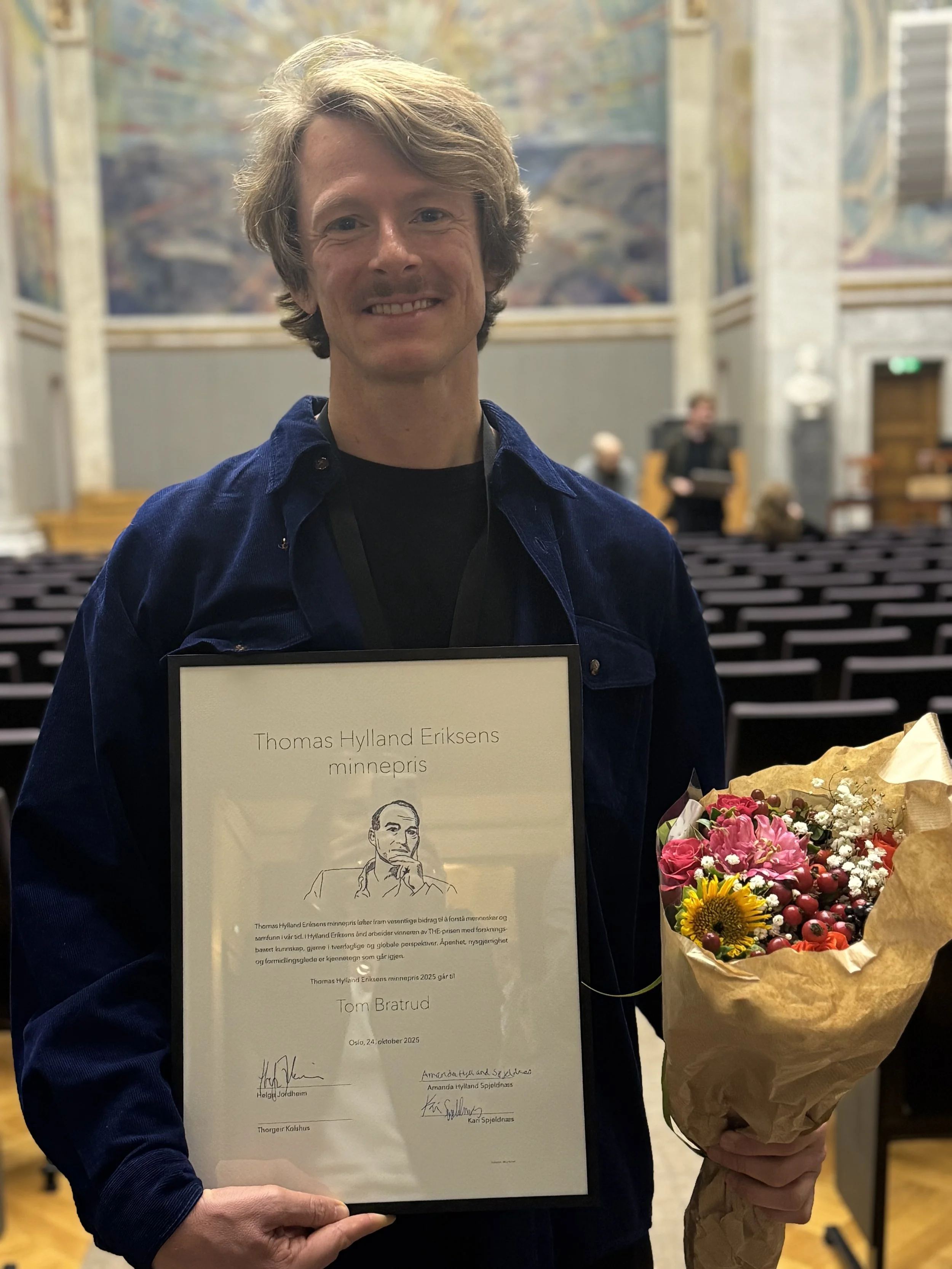
Rana Issa is the second recipient of the Thomas Hylland Eriksen Memorial Prize. The first recipient was the social anthropologist, Tom Bratrud. The THE Prize highlights significant contributions to understanding people and societies in our time. In the spirit of Thomas Hylland Eriksen, the winner of the THE Prize works with research-based knowledge, often in interdisciplinary and global perspectives. Openness, curiosity, and enthusiasm for communication are key characteristics of the award recipient.
The THE Prize amounts to NOK 50,000 and will be awarded annually for ten years starting in 2025. The award committee, which selects the annual winner, consists of Helge Jordheim, Director of the Centre for Global Sustainability; Thorgeir Kolshus, Head of the Department of Social Anthropology at the University of Oslo; and Amanda Hylland Spjeldnæs and Kari Spjeldnæs from Thomas Hylland Eriksen’s family. The financial basis for the prize comes from the proceeds of Thomas Hylland Eriksen’s authorship.
Sámi approaches to history, politics and belonging
London: Routledge 2020.
This book is a collaborative effort, co-edited with Sanna Valkonen and Jarno Valkonen, and it is a contribution to the ongoing attempt to bridge academic knowledge and indigenous knowledges.
Focusing on the Sápmi region of Northern Europe as a point of departure, the book enriches and sharpens the concept of 'the North.' It combines detailed empirical research on the Sámi people and their life-worlds with theoretical contributions from leading scholars. The authors consider the European North not only as a geographical site or an object of academic research, but as a particular way of knowing and being, with its own needs, practices, concepts, and imaginings. The North, as an epistemic position, offers its own conceptions of politics, human agency, history, and social relations, which this book studies and describes. The volume challenges us to consider social scientific knowledge, its significance, and the practices of producing it in a new way.
You can take a closer look (and even buy it) from the publisher’s website.
Co-edited with Astrid B. Stensrud, this is the fifth book in the Overheating series on Pluto Press. Previous books have looked at identity, mining, runaway globalisation in Australia and overheating as a lens through which to interpret contemporary globalisation.
This book emphasises the relationship between climate change and the capitalist growth economy, and — in a comparative spirit — has contributions dealing with Argentina, Mongolia, Peru, India, Greenland and the Pacific.
As the co-editor, I should mention that Astrid did the lion’s share of the work. I was ill for a long time and remain grateful to her for taking responsibility. Proud of the result!
You may read more about the book, and perhaps even order it, from Pluto Press.
A Legacy of Fifty Years
Routledge, 2019
The publication of Fredrik Barth’s Ethnic Groups and Boundaries marked a milestone in the conceptualization of ethnicity and ethnic groups and opened a new field of enquiry in the social scientific study of ethnicity.
Ethnic Groups and Boundaries Today: A Legacy of Fifty Years demonstrates the enduring significance of the work, identifying its shortcomings and showcasing the state of the art today, fifty years after the publication of the groundbreaking original. Bringing together a team of stellar contributors, all of whom have been inspired by Barth's theory and have made significant contributions of their own to the theorisation and research of ethnicity, this volume assesses the theoretical approach presented in Ethnic Groups and Boundaries, both in the context of its time and with the hindsight of the developments in the social sciences since then. It emphasizes the legacy of the original text and determines its significance, whilst identifying and elaborating on the main lines of the subsequent developments of the concept of ethnicity that were influenced by Ethnic Groups and Boundaries, but that have since developed and superseded the original. As such, it will appeal to scholars across the social sciences with interests in the concept and study of ethnicity.
Here’s the book at the publisher’s page.
Extractive Industries in an Overheated World
Edited by Robert Jan Pijpers and Thomas Hylland Eriksen
Pluto Press, 2018
In a fast-changing world, where the extraction of natural resources is key to development, whilst also creating environmental and social disasters, understanding how landscapes, people and politics are shaped by extraction is crucial.
Looking at resource extraction in numerous locations at different stages of development, including North, West and South Africa, India, Kazakhstan and Australia, a broad picture is created, covering coal, natural-gas, gold and cement mining, from corporate to 'artisanal' extraction, from the large to the small scale. The chapters answer the questions: What is ideological about resource extraction? How does extraction transform the physical landscape? And how does the extractive process determine which stakeholders become dominant or marginalised?
Contributing to policy debates, Mining Encounters uncovers the tensions, negotiations and disparities between different actors in the extractive industries, including exploiters and those who benefit or are impoverished by resource exploitation.
Runaway Globalisation on the Queensland Coast
Pluto Press, 2018
Sitting next to the Great Barrier Reef, marinated in coal and gas, the industrial boomtown of Gladstone, Australia embodies many of the contradictions of the 'overheated' world: prosperous yet polluted; growing and developing yet always on the precipice of uncertainty.
Capturing Gladstone at the peak of its accelerated growth in 2013-14, Thomas Hylland Eriksen dissects the boomtown phenomenon in all its profound ambivalence. Based on ethnographic fieldwork, the book explores the tensions and resentments surrounding migrant workers, and examines local identity, family life, infrastructure and local services.
Writ large in Boomtown are the clashes of scale at the heart of the town's contradictions - where the logic of big industry and the state compete with that of the individual, local communities and ecology, revealing the current crisis of political legitimacy across the world.
A presentation of the book by the publisher can be found here.
Fifty years of Development. Diversity and Democracy
Edited by Thomas Hylland Eriksen and Ramola Ramtohul
University of Mauritius Press, 2018
Speaking of Mauritius as an economic miracle has become a cliché, and with good reason: Its development since Independence in 1968 can easily be narrated as a rags-to-riches story. In addition, it is a stable democracy capable of containing the conflict potential inherent in its complex ethnic and religious demography.
This book brings together some of the finest scholarship, domestic as well as foreign, on contemporary Mauritius, offering perspectives from constitutional law, cultural studies, sociology, archaeology, economics, social anthropology and more. While celebrating the indisputable, and impressive, achievements of the Mauritian nation on its fiftieth birthday, this book is far from toothless. Looking back inevitably implies looking ahead, and in order to do so, critical self-scrutiny is essential, to be able to learn from the mistakes of the past.
The contributors raise fundamental questions concerning a broad range of issues, from the dilemmas of multiculturalism to the marginal role of women in public life, from the question of constitutional reform and the continued problem of corruption to the slow destruction of Mauritius’ joy and pride, namely the beauty and purity of its natural scenery. Taking stock of the first fifty years, this book also looks ahead to the next fifty years, giving some cues as to where Mauritius can and should aim in the next decades.
The editors: Since he first did fieldwork in Mauritius on ethnic dynamics and their relationship to national identity in 1986, Thomas Hylland Eriksen has followed the economic, cultural and political situation in the island. Ramola Ramtohul, a sociologist working at the University of Mauritius, is a prolific researcher on education, feminism and women's activism in the island, and is currently researching, among other projects, the implications of foreign investments in real estate.
Edited by Thomas Hylland Eriksen and Elisabeth Schober
Department of Social Anthropology, University of Oslo, 2017
Suddenly, we seem to live in a time dominated by ‘fake news’, ‘alternative facts’, conspiracy theories, scepticism of scientific research, partial accounts parading as ‘the real truth which has hitherto been concealed from us, the people’, revolts against allegedly smug academic elites and distant political elites – a time where YouTube videos claiming research into climate change to be a scam get far more viewers than videos presenting the science of climate change. In this world, where the authority of science and empirical methods is being questioned and where even world leaders may brush aside uncomfortable facts as ‘fake news’, it is increasingly difficult to know whose knowledge to trust. This insight is the starting point of this collection of articles, which has grown out of a workshop organised by the ERC AdvGr project ‘Overheating: The Three Crises of Globalisation’ in Oslo in 2015. We are very pleased to be able to offer these texts as a free e-book, not least considering the fact that its subject-matter is knowledge.
Contributors to the book are Ben Campbell, Elisabeth Schober, Desmond McNeill, Christina Garsten and Thomas Hylland Eriksen. Art direction and technical expertise by Maria Kartveit.
Thomas Hylland Eriksen is Professor of Social Anthropology at the University of Oslo and PI of the ERC AdvGr project ‘Overheating’. His most recent books in English are Globalization: The Key Concepts (2nd ed., 2014), Fredrik Barth: An Intellectual Biography (2015) and Overheating: Coming to Terms With Accelerated Change (2016).
Elisabeth Schober is an Associate Professor at the Department of Social Anthropology, University of Oslo. As part of the Prof. Thomas Hylland Eriksen’s “Overheating”-research project, she has recently undertaken seven months of ethnographic field research in the Philippines and South Korea. Previous research of hers on the US military presence in Seoul, South Korea, forms the premise of her most recent monograph “Base Encounters. The US Armed Forces” (2016, Pluto).
The ebook is available here.
An Anthropological History of the Early Twenty-first Century
Taylor & Francis Ltd, 2017
Although economic, cultural and demographic changes are part and parcel of the modern world, changes in a number of areas have accelerated in the last quarter-century - a period sometimes spoken of as the global information society, a world of `liquid modernity' - or of fully-fledged global neoliberalism associated with deregulation, flexible accumulation and financialisation.
At a global level, some of the substantial areas where change has accelerated are, apart from the spectacular spread of new information technology, tourism, foreign direct investment, urbanisation, resource extraction through mining, energy use, species extinction, displacement, and international trade. These and other changes are, needless to say, perceived and acted upon differently in different countries and localities, and in order to understand the implications of the present acceleration of history, they have to be explored locally.
This book gives a compelling perspective on the contemporary, `overheated' world, presenting ethnographic material from many countries and weaving the local and particular together with large-scale global acceleration. This book was first published as a special issue of History and Anthropology.
Living in an Overheated World
Pluto Press, 2016
The world is overheated: Too full and too fast; out of sync, contradiction-ridden and unequal. It is the age of the Anthropocene, of humanity’s indelible mark upon the planet. In short, it is globalisation - but not as we know it.
The publisher’s presentation of the book can be found here.
This collection explores social identities in today’s ‘overheated’ world, seen from an anthropological perspective. The focus is on contradictions, tensions and paradoxes: How can an identity be stable if its border is constantly shifting? How can a community survive if it is incorporated into a huge entity? How does belonging work in new cities? And what can indigenous peoples do to retain a sense of self in a fast-moving neoliberal world?
Ethnographically rich and diverse in its scope, ntains chapters from many parts of the world, including the Philippines, Israel, Australia, the Cape Verde Islands and Afghanistan. The authors investigate how identity changes in response to contemporary forces, from rapid industrialisation, the enforced return of migrants and the silencing of indigenous groups to sudden population growth in boomtowns and the touristification of local culture.
Publishers page can be accessed here.
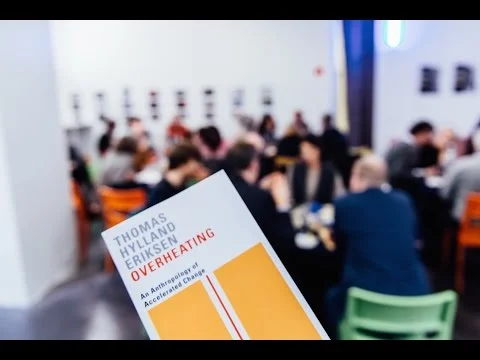
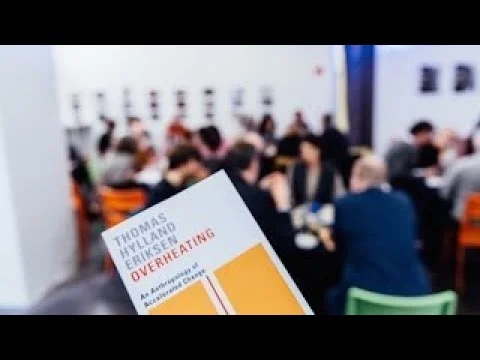
An Anthropology of Accelerated Change
Pluto Press, 2016
The world is overheated. Too full and too fast; uneven and unequal. It is the age of the Anthropocene, of humanity's indelible mark upon the planet. In short, it is globalisation - but not as we know it.
In this groundbreaking book, Thomas Hylland Eriksen breathes new life into the discussion around global modernity, bringing an anthropologist's approach to bear on the three interrelated crises of environment, economy and identity. He argues that although these crises are global in scope, they are perceived and responded to locally, and that contradictions abound between the standardising forces of information-age global capitalism and the socially embedded nature of people and local practices.
Carefully synthesising the ethnographic and comparative methods of anthropology with macrosocial and historical material, offers an innovative new perspective on issues including energy use, urbanisation, deprivation, human (im)mobility, and the spread of interconnected, wireless information technology.
Publishers page can be found here.
An Intellectual Biography
Pluto Books, 2015
A lightly edited and translated version of the 2013 biography. This is how it is presented on Amazon: ‘Fredrik Barth is one of the towering figures of twentieth-century anthropology. This intellectual history traces the development of Barth’s ideas and explores the substance of his contributions. In an accessible style, Thomas Eriksen’s biographical study reveals the magic of ethnography to professional anthropologists and non-practitioners alike. Exploring his six decade career, it follows Barth from early ecological studies in Pakistan, to political studies in Iran, to groundbreaking fieldwork in Norway, New Guinea, Bali and Bhutan. Eriksen argues that Barth's voracious appetite for fieldwork holds the key to understanding his remarkable intellectual development and the insights it produced. The book raises many of the same questions that emerge from Barth's own work - of unity and diversity, of culture and relativism, of art and science. Thomas Eriksen is himself a major contributor to the study of anthropology, as well as a distinguished educator, and is therefore ideally placed to introduce the life and work of Fredrik Barth. This will surely be the definitive book on its subject for many years to come.’
Publisher´s page can be found here.
Pluto Press, 2004/2017
This book came about as follows. In 2003, I was invited to contribute a short, introductory book (not primarily for students, but for that almost mythical entity called the interested layperson) about social anthropology. It was to be written in Norwegian, and would subsequently be published by Universitetsforlaget (HVA ER sosialantropologi?). When, soon after, I got the chance to translate it into English, I included the two chapters that, for reasons of length, had to be omitted from the Norwegian edition (those on thought and nature). As a result, the English edition is somewhat fuller and (to my mind) slightly more satisfactory than the original.
A sample can be accessed here.
The publisher has this to say about it.
Introduction to Social and Cultural Anthropology
Pluto Press, 1995/2000/2010
Little did I know, when I was drafting the first, Norwegian edition of this book in 1992, that I'd still be working on the same book two decades later. Third, revised and updated editions of both the Norwegian and English editions were publised simultaneously in May 2010. And it now seems exceedingly likely that there will be a fourth edition published in the next couple of years.
This book is, in all of its incarnations, an introduction to social and cultural anthropology written by a practitioner who believes in ‘the militant middle ground’ (Michael Herzfeld's term). There is no attempt here to redefine the field radically, or to ride hobbyhorses along paths seen only by the author. In my view, that kind of strategy would have been irresponsible, and would have rendered the book far less useful as a first full introduction to anthropology at the university level. Inevitably, ‘my kind of anthropology’ shines through – it is probably more ‘European’ than ‘American’ in its dominant approach – but the book should be reasonably representative of anthropology as it is being practiced across the world today. Omissions are many (again this is inevitable), but at least it is getting better with each edition. Or so I think. Otherwise I wouldn't have bothered.
A chapter from the first (1995) edition can be read here.
The publisher presents the fourth edition of the book here.
With Finn Sivert Nielsen
Pluto Press, 2001/2013
It was on the eve of the millennium. My colleague Finn Sivert Nielsen had just written a great book about field methodology (in Norwegian), and I had written quite a bit myself. When we were approached by Fagbokforlaget in Bergen (hello, Tor Paulson!) with a request to write a history of anthropology, we pounced on the idea, although it took a while for us actually to write the thing. A long while, to be precise. Finn has a great eye for detail, anecdote and fact, while I seem to have a rather un-anthropological flair for the large canvas. We felt that the writing process went pretty smoothly, drafts bouncing back and forth in cyberspace for weeks and months. Pluto wanted an English edition, and we duly translated and condensed the somewhat bulky Norwegian book. After a decade or so, it was time for an update and revision, and I think Finn was especially pleased with this, as it enabled us (actually, mostly him) to correct a handful of embarrassing errors in the first edition. In addition to rewriting not only the recent past, but perhaps to an even greater extent the slightly more distant past. It somehow seemed that between 2001 and 2012, the 1870 changed more than the 1970s did.
A chapter from the first edition can be read here, while the preface to the second edition and a sample chapter have been made available here.
You can also read about the book here.
Essays in Honor of Ulf Hannerz
Berghahn Books, 2014
Edited by Thomas Hylland Eriksen, Christina Garsten and Shalini Randeria
The scholarship of Ulf Hannerz is characterized by its extraordinary breadth and visionary nature. He has contributed to the understanding of urban life and transnational networks, and the role of media, paradoxes of identity and new forms of community, suggesting to see culture in terms of flows rather than as bounded entities. Contributions honor Hannerz’ legacy by addressing theoretical, epistemological, ethical and methodological challenges facing anthropological inquiry on topics from cultural diversity policies in Europe to transnational networks in Yemen, and from pottery and literature to multinational corporations.
The Key Concepts
Berg 2007/Bloomsbury 2014
First published in 2007, this book demanded a substantial amount of work when the time came for a revision and update. Seven years can be a long time when many of the empirical examples refer to contemporary events. The new edition also bears the mark of my recent and current research on accelerated change. From the new preface: ‘We live in a shrunken world, a world of contacts, frictions, comparisons, communication and movements which are sometimes unrestricted by distance. At the same time, and partly for that very reason, boundary-making of various kinds has gained a new and heightened significance through attempts to stem and regulate such flows, and besides, many human activities continue to take place without any consequences beyond the local. The aim of this book is to outline some of the main dimensions of globalization, to highlight its dual (local/non-local) character, and to indicate some ways in which they are being studied and critiqued. ’
The Preface and Introduction of the first edition have been made available here, while the chapter on disembedding from the second edition can be read here.
This is the publisher's presentation.
Anthropological Perspectives on Human Security
Pluto Press, 2010
Edited with Ellen Bal and Oscar Salemink at the Free University of Amsterdam, where I had a Special Chair from 2004 to 2006, this book explores the possible uses of the concept of human security in anthropology.
The concept of human security was introduced by the UNDP in 1994, in order to expand the scope of development work and research. Human security is defined as ‘freedom from want and freedom from fear’, and thus includes the subjective or existential dimensions in an area which has been dominated by quantitative and ‘objective’ measurements of well-being.
So far, the concept of human security has been largely absent from academic anthropology. This is regrettable insofar as anthropologists thereby exclude themselves from relevant theoretical and policy debates that touch on the heart of the discipline, as well as from potentially fruitful exchanges with other disciplines. This book represents an effort to sharpen and broaden the scope of human security research, placing it at the very centre of social inquiry.
The introductory chapter can be read here.
The publisher's page is here.
Perspectives from Northern Europe
Ashgate, 2009
Edited with Sharam Alghasi and Halleh Ghorashi, this book brings together researchers working with minority–majority issues in the Netherlands and Norway (with fleeting glances to the UK and Sweden). Explicitly comparative in its approach, Paradoxes of Cultural Recognition discusses central issues regarding multiculturalism in today's Europe, based on studies of Norway and the Netherlands. Distinguishing clearly the four social fields of the media, education, the labour market and issues relating to gender, it presents empirical case studies, which offer valuable insights into the nature of majority/minority relationships, whilst raising theoretical questions relevant for further comparisons.
The first chapter can be viewed here.
The publisher's page is here.
Routledge, 2007
A labour of love, this edited volume began as a workshop I co-organised with Richard Jenkins at Lysebu in the picturesque and, at the time, icy cold forest above Oslo in December ... 2006, it must have been. Bringing together a clutch of scholars from a variety of disciplines who shared a passion for flags, we seemed to cover the entire range, from nerdy focus on minuscule detail to grand and irresponsible theories about modernity and human nature. The result ... well, at least it was enjoyable for us. The chapters deal largely with North America and North-Western Europe. The sub-title could actually have been ‘A North Atlantic Perspective’. Recommended for anyone interested in nationalism and symbolism.
My introductory chapter can be downloaded via this link.
This is what the publisher says.
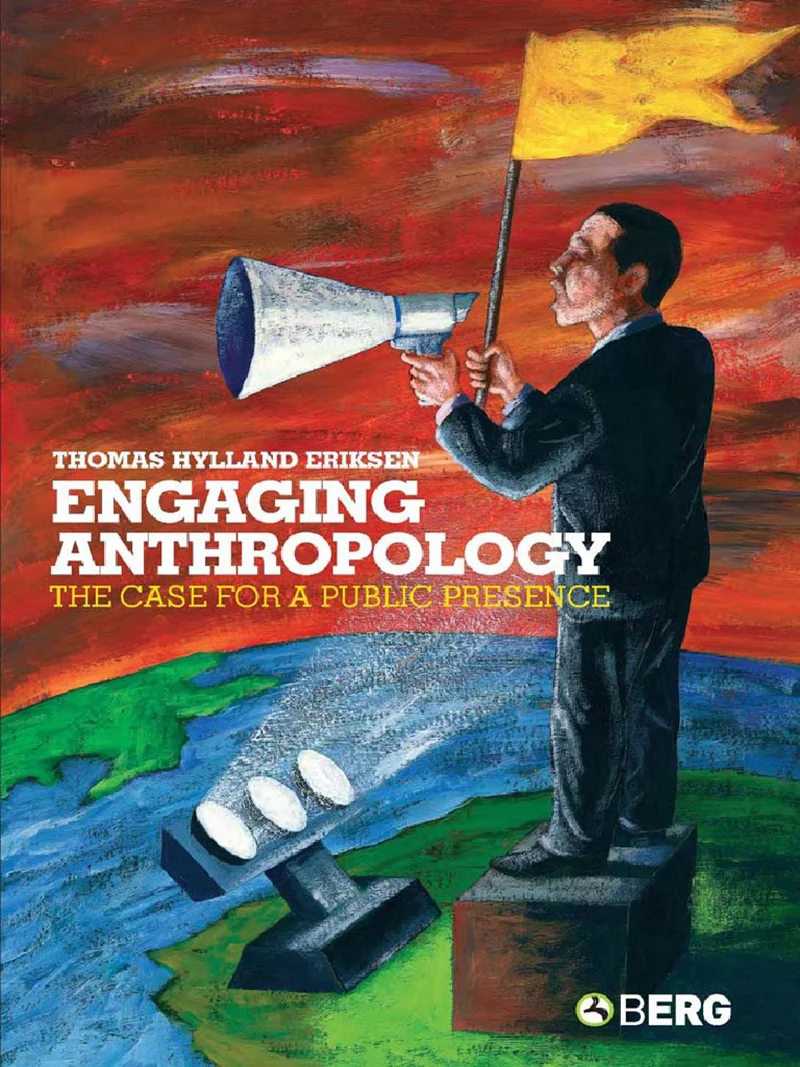
The Case for a Public Presence
Berg, 2006
One of my most personal books in English, this long essay argues that anthropology should reclaim its place as a central intellectual discipline – but that in order to do so, we must ask lucid questions and explore them in engaging, intelligible ways. Since the book was published, obscurantism has returned with a vengeance, but so has a widespread desire to take part in the big conversation about who we are and where we are going.
This is what the publisher says: ‘Engaging Anthropology takes an unflinching look at why the discipline has not gained the popularity and respect it deserves in the twenty-first century.While showcasing the intellectual power of discipline, Eriksen takes the anthropological community to task for its unwillingness to engage more proactively with the media in a wide range of current debates, from immigrant issues to biotechnology. Eriksen argues that anthropology needs to rediscover the art of narrative and abandon arid analysis and, more provocatively, anthropologists need to lose their fear of plunging into the vexed issues modern societies present.’
The book is presented more fully here.
The publisher presents the book here, and I am pleased to see that it can be bought as an e-book directly from them.
Ethnicity, Nationalism and the Politics of Compromise in Mauritius
Berg, 1998
An anthropological monograph based on my fieldwork in Mauritius (1986 and 1991/92), this book uses the ethnic and cultural complexity of Mauritius as a context for raising questions of broader relevance: Can multiethnic nations be stable and meaningful imagined communities? Are multiethnic societies necessarily multicultural ones, or is the very term 'multicultural society' a contradiction in terms? To what extent do processes of modernisation lead to an obliteration of ethnic boundaries, and in what ways are the very same boundaries strengthened through social change? Is it possible to avoid discrimination against minorities in multiethnic society? How can ethnic conflict be avoided? And what does the word 'we' mean? Questions, I should add, that I have been pursuing in much of my later work elsewhere, not least in my native Norway.
A chapter from the book has been made available here.
The publisher presents the book here.
Fast and Slow Time in the Information Age
Pluto Press, 2001
This book, published in Norwegian in January 2001 and in English in the same autumn, became an unexpected success, in the sense that it was translated into lots of languages and enjoyed healthy sales in several countries. I still (2014) receive requests to give public talks about the subject, which must have struck a nerve in the turn-of-the-millennium Zeitgeist.
The publisher says this (among other things): The turn of the millennium is characterized by exponential growth in everything related to communication – from the internet and email to air traffic. Tyranny of the Moment deals with some of the most perplexing paradoxes of this new information age. Who would have expected that apparently time-saving technology results in time being scarcer than ever? And has this seemingly limitless access to information led to confusion rather than enlightenment?
In my current Overheating research, I'm building on some of the ideas first developed in Tyranny of the Moment, notably that of converging exponential growth curves in otherwise distinct areas, as well as flexibility as a key variable.
The book is presented here.
The publisher presents it here. By the way, I am pleased to see that it is still on display, thanks, Pluto!
Ethnicity and Nationalism in Trinidad, Mauritius and Beyond
Scandinavian University Press, 1992
Thanks to the anthropologist Berit Berge, then an energetic and innovative editor with the Scandinavian University Press/Universitetsforlaget, I got the opportunity to publish this book, somehow out of turn. (Soon after, she invited me to write an introductory textbook in social anthropology for Norwegian students – the book that would turn into Small Places, Large Issues in English.) This is not a monograph. It is not even my Ph D dissertation, but a collection of articles, published and unpublished, framed by a newly written introduction (and a generous preface by one of my heroes, Professor Bruce Kapferer). It is about groups, boundaries, pluralism, the straitjacket of ethnicity as well as its existential and material rewards, non-ethnic nations and the difficulties of moulding imagined communities out of diverse human materials. First and foremost, it is about two tropical islands which did not only shape my anthropological interests, but also taught me a number of lessons about life, the universe and everything.
The book is now hard to find outside of well-stocked university libraries, and for that reason, I've made parts of it available in two formats on this site. The first chapter (in html) is here, and a couple of later chapters can be downloaded (in pdf) here.
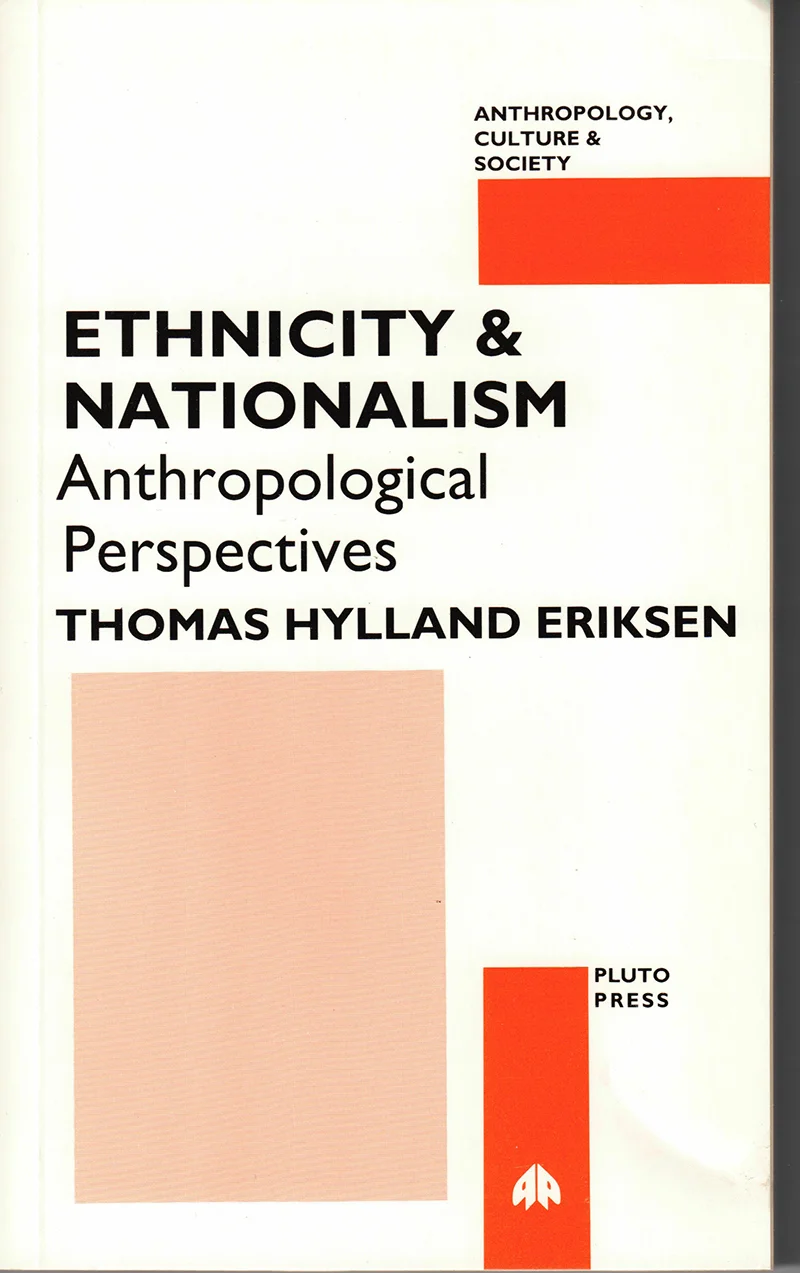
Anthropological Perspectives
Pluto Press, 1993, 2002, 2010
As with Small Places, Large Issues, this book has followed me throughout my professional life – I was thirty when I wrote it – to an extent I couldn't possibly anticipate at the time. When Richard A. Wilson, editor of the brand new Anthropology, Culture & Society series at Pluto Press, asked me if I would consider the possibility of writing an introduction to ethnicity, I was surprised and flattered. Naturally, I felt I had to give it a try, and this spontaneous decision would, as it turned out, mark the start not only of many years of collaboration with Anne Beech and Pluto Press, but also the beginning of a long and rewarding friendship with Richard and his family. Not that I knew much about him, or Pluto, when I set to work. Beyond the bare bones of embryonic e-mail, we didn't have Internet at the time, and I couldn't google the enigmatic Dr. Wilson, and so I naturally imagined him to be an elderly don with the natural authority that befits a book series editor (benevolently bearded, pipe-smoking, tweeded etc). It was only when we met in London that I came to realise that he was younger than myself. Blimey.
It was easy, and fun, to write this book back in 1992. I based the scaffolding on my lectures on ethnicity and nationalism at the University of Oslo, adding and subtracting, elaborating and condensing as I went along. The subsequent revisions were harder. The field had grown in all sorts of directions, and I had grown somewhat more ambivalent myself. If anything, the third (2010) edition has the advantage of being more nuanced (and hopefully more mature) than the first (1993) one. It is theoretically updated, but not only academic views of the world, but aspects of the world out there have changed in the last couple of decades. There is, accordingly, increased attention to the growth of politicised religion, for example in India and the Middle East, the increased commercialisation of identity in a neoliberal world, the heightened tensions between quests for purity and hybrid identities and so on. I should nevertheless concede that the cover design has improved immeasurably more than the stuff inside the covers.
The first edition is presented here.
The third edition is presented here.
And the publishers have their say here.
Linguistic Minorities and the Nation-State
PRIO Report no. 5, 1991
Too long to be an article, but too short to be a book, this extended essay was published as a PRIO report (the International Peace Research Institute, where I spent a year as a research fellow in 1990–91). Written simultaneously with my Ph D, ‘Languages’ is an attempt to think through the relationship between equal rights and the right to be different in the context of the homogenising pressures of the modern nation-state. As the title implies, the empirical focus was on language, which had been less central to my doctoral work. This is the original abstract:
On the one hand, cultural differences in the contemporary world seem to vanish rapidly. This is effected through homogenising processes of economic and political integration into nation-states and into the global system, as well as the globalisation of culture brought about through modern means of mass communication. On the other hand, the last decades has seen the widespread resurgence of ethnic sentiments and revitalisation of local cultural identities. This apparent paradox is seen as an inherent aspect of modernity.
The processes of integration into nation-states puts strong pressures on minorities to assimilate. For this reason, many minority languages are threatened. The text, defending the rights of minority languages and criticising their nationalist antagonists, compares several linguistic minorities. The comparison focuses on their relationship with the nation-states to which they are subjected, their strategies of resistance, and problems in challenging linguistic hegemony. Perhaps paradoxically, cultural minorities may have to assimilate culturally in important respects in order to present their case effectively and thereby retain their minority identity.
A main conclusion emerging from the comparisons is that states need not be nation-states relying on nationalist ideologies proclaiming the virtues of absolute cultural homogeneity. Although they may be unspectacular, forms of linguistic oppression are forms of oppression no less, and demand the attention of peace and conflict researchers."
Since the report is out of print, it is reproduced in its entirety here.
Ethnicity and Nationalism in Mauritius
Department of Social Anthropology, Univ. of Oslo: Occasional Papers in Social Anthropology, 1988
Originally an MPhil* dissertation in social anthropology, this was my first full-length book, modestly but properly published in the Occasional Papers series at the Department of Social Anthropology, University of Oslo. It presents the history of Mauritius – slavery, Indian indentureship, wars between France and Britain, Independence – briefly before moving to the analysis proper. Its focus is the maintenance of ethnic boundaries between the main categories of Creoles (Catholics of largely African descent), Hindus, Muslims, Tamils, Chinese and Franco-Mauritians; as well as discussing the conditions for a multi-ethnic Mauritian nation. I later came to realise that the idea of a multi-ethnic nation is a rather controversial one among theorists of nationalism, many of whom tend to see nations as identical with ethnic groups which control a state. Nevertheless, I argue that the sense of nationhood is sometimes strong in Mauritius and occasionally surpasses ethnic loyalty in importance. In my later work on Mauritius, I moved a step further and looked at interethnic marriages and the emergence of hybrid and post-ethnic identities.
The concluding chapter can be read here. However, I was recently given to understand that the entire book is available as a PDF file, so here it is!
* Since 2003, the Norwegian academic system has been standardised in accordance with the European ‘Bologna Process’, and we now have two-year MA degrees. In the old days, however, the postgraduate degree in anthropology in theory took three and a half years (in practice often longer), and involved a full year of fieldwork. As a result, a cand. polit. (MPhil) dissertation could easily run for two or three hundred pages.
Talk by Thomas Hylland Eriksen in the Futures Lecture Series at Aarhus University with the title: "Overheating: Coming to terms with accelerated change" A rapidly changing world requires new ways of thinking and acting. The Futures Lecture Series features cutting-edge speakers from the arts and social sciences whose cross-disciplinary scholarship and ground-breaking insights help all of us rethink the urgent challenges of the contemporary world.
Foredragsholder: Thomas Hylland Eriksen, professor, sosialantropolog, forfatter og samfunnsdebattant
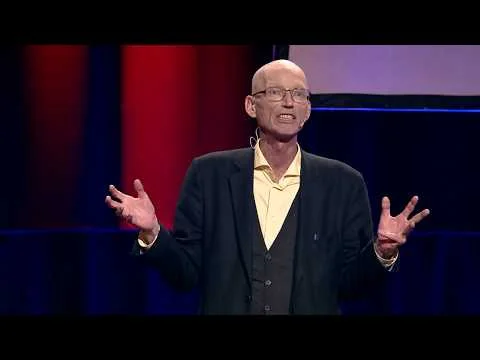
In a world of more, faster, bigger and warmer, we are overheating on both the personal level and the global level. This brilliant talk from renowned Norwegian social anthropologist Thomas Hylland Eriksen will give you food for thought, and a perfect excuse to slow down for 10 minutes. Thomas Hylland Eriksen is a social anthropologist and author of Overheating: An Anthropology of Accelerated Change (2016). Thomas is currently a Professor of Social Anthropology at the University of Oslo and has authored textbooks, academic monographs, polemical interventions, popular science, biographies and novels in both English and Norwegian. Born from his long-standing interest in the unintentional consequences of modernity, is a series of four books focusing on information technology, identity, happiness and waste. Thomas recently completed a five-year research project which shows how global change has accelerated in many domains, from coal exports to photography and from finance to identity politics; leading to dangerous ‘overheating effects’ and a need to slow down, or ‘cool down’ worldwide. This talk was given at a TEDx event using the TED conference format but independently organized by a local community. Learn more at https://www.ted.com/tedx
In this short video Prof. Thomas Hylland Eriksen outlines the concept of 'overheating', at the core of his new book for Pluto Press, published June 2016. To find out more about the book go to: www.plutobooks.com.
The world is overheated. Too full and too fast; uneven and unequal.
Gegužės 7-8 dienomis Vytauto Didžiojo universitete (VDU) lankėsi bei viešą paskaitą ir seminarą vedė Thomas Hyllandas Eriksenas – vienas garsiausių šiandienos pasaulio antropologų, Oslo universiteto socialinės antropologijos profesorius, Europos socialinių antropologų asociacijos EASA prezidentas (2015-2016), Norvegijos Mokslo akademijos narys.
***
On 7-8, May, two lectures were held at Vytautas Magnus University by Thomas Hylland Eriksen, one of world's most prominent anthropologists, who is currently a professor of Social Anthropology at the University of Oslo, the President of the European Association of Social Anthropologists, EASA (2015-2016), and member of the Norwegian Academy of Science and Letters.
Panel Debate and Q&A with Thomas Hylland Eriksen in the Futures Lecture Series following his talk "Overheating: Coming to terms with accelerated change." A rapidly changing world requires new ways of thinking and acting. The Futures Lecture Series features cutting-edge speakers from the arts and social sciences whose cross-disciplinary scholarship and ground-breaking insights help all of us rethink the urgent challenges of the contemporary world.
Gjester: Thomas Hylland Eriksen og Dag O. Hessen. Med blant annet Kristin Skogheim som vikar for Linn Skåber. TV-sendt den 14, September 2012.
Economic crisis and politics of identity in Europe, Thomas Hylland Eriksen, Professor, University of Oslo
Sue Christoforou, policy and research manager, The Equality Trust project, One Society; policy analyst Thomas Hylland Eriksen, professor of social anthropology, University of Oslo; novelist; author, Ethnicity and Nationalism and Globalization: the key concepts Joyce McMillan, chair, Hansard Society Working Group in Scotland; judge, 2010 Saltire Scottish Book of the Year Award; theatre critic, Scotsman Brendan O'Neill, editor, spiked; author, Can I Recycle My Granny and 39 Other Eco-Dilemmas Trevor Phillips, former chair, Equality and Human Rights Commission Chair: Claire Fox, director, Institute of Ideas; panellist, BBC Radio 4's Moral Maze In his State of the Union speech this year, President Obama declared that inequality is 'the defining issue of our time'. He said everyone should get 'a fair shot', do 'their fair share' and play by 'the same set of rules'. Such fairness, such equality, was a matter beyond politics ('not Democratic values or Republican values, but American values'), something without which the very fabric of society was at risk. In the UK, too, Prime Minister David Cameron has railed against 'the incredible inequality of the modern world'. Economic debates are dominated by the spectre of dangerous inequalities. From Richard Layard's economics of happiness, with its focus on relative income and the 'paradox of prosperity', to the fashionable endorsement of The Spirit Level, a bestselling book by academics much cited by politicians of all parties, to the Occupy movement, it has become an orthodoxy that unequal societies do worse in education, mental health and social cohesion. The moral force of demands to lessen economic inequality seems to derive from the historically progressive demands for political equality. Who can object to that call for equal rights, whereby groups oppressed because of their gender, race or sexuality fought for their democratic rights? But does the fairness agenda really stand in the tradition of anti-slavery, civil rights and women's suffrage? Is demanding regulation of bankers' pay or calling for a mansion tax of the same order as the fight against Apartheid or the decriminalisation of homosexuality? Or are we in danger of confusing what we mean by equality by conflating the economic with the political? The origin of the modern idea that 'All men are created equal' lies in Thomas Jefferson's 'immortal declaration' in which equality was inalienably linked to liberty as a rebuttal against authoritarian rule. And yet demands for more equality can be used against individual freedom, religious freedom, free enterprise. Equal rights for minority groups may be progressive, but what about contemporary equal opportunity policies, such as quotas, that emphasise equality of outcomes? Talent is not equally distributed: some of us are fast, some bright, some musical. Some are not. That might not be 'fair', but there it is: we are not all born the same. Is it fair to discriminate and handicap to level the playing field? Or does such affirmative action come at too high a price in personal freedom? Do we really want economic redistribution to the level that we all have the same? Is the importance of equality more in allowing us to be different or in allowing us to be the same? What has equality come to mean today?
Professor Thomas Hylland Eriksen, University of Oslo, Norway, presents that for a politically engaged social theorist, Ernest Gellner was surprisingly uninterested in analysing the contemporary identity politics arising from migration into the West. In several of his books and essays there are hints about his attitudes to multiculturalism and the new cultural configurations, but he never began to analyse the impact of migration on European political identities. However, many of Gellner's writings provide ideas and facts which are clearly relevant for such an enterprise. His views on liberalism and romanticism, his work on the collapse of empires and the rise of nationalism, and perhaps most notably his writings about the societal foundations of ideology, offer rich and challenging input to any discussion of cultural pluralism and national (or post-national?) identities. The paper will amount to an analysis of contemporary dynamics of cultural identity in selected European societies, taking its analytic cues from Gellner's work.
This video was recorded during the “Social and Political Relevance of Gellner's Thought Today” conference organised by Dr Sinisa Malesevic and Dr Mark Haugaard, Dept of Political Science and Sociology, in the National University of Ireland, Galway. This conference was held on 21-22 May 2005. Organised at the eve of the 10th anniversary of Gellner’s death, it brought together some of the world’s most prominent social scientists whose own work, in one way or another, is indebted to the legacy of Ernest Gellner (1925-1995).
National University of Ireland, Galway
Video Production/Edition: Maria-Alejandra Gonzalez-Perez
Conference Organiser: Mark Haugaard
Conference Organiser: Sinisa Malesevic
Thomas Hylland Eriksen is among the most distinguished anthropologists of our times. He is currently Professor of social anthropology at the University of Oslo, and leads the Overheating project funded by the European Research Council. A prolific writer, he has authored many books and has contributed considerably to popularising social anthropology through his work. He writes and talks in many genres about the contemporary world, what it means to be human and how the world can be made a better place. When not teaching, writing, or speaking around the world, you can find him absorbed in people watching in Trinidad or Mauritius. Recorded in Brussels on 15th November 2016
The world is overheated – and we aren’t just referring to climate change. It’s too full, too fast and developments are uneven and unequal. Everything takes place faster and change is more comprehensive than ever before. “It’s globalisation, but not as we know it!” Leading Norwegian anthropologist Thomas Hylland Eriksen discusses accelerated change and its long-term implications for us, while dissecting the three major crisis of globalisation – economy, climate, and identity. Is there any alternative to this great acceleration? Can we live slower? Can we get out of the corner into which we have painted ourselves? There is no simple answer, and yet tackling the unintentional side effects of modernity is the single most important question of our times. ABOUT Thomas Hylland Eriksen is among the most distinguished anthropologists of our times. He is currently Professor of social anthropology at the University of Oslo, and leads the Overheating project funded by the European Research Council. A prolific writer, he has authored many books and has contributed considerably to popularising social anthropology through his work. He writes and talks in many genres about the contemporary world, what it means to be human and how the world can be made a better place. GOOD READS Overheating: an anthropology of accelerated change (2016), Globalization, the key concepts (2014), A history of anthropology (2013), A world of insecurity (2010), Small places, large issues (2010), What is anthropology? (2004), Tyranny of the moment: fast and slow time in the information age (2001).
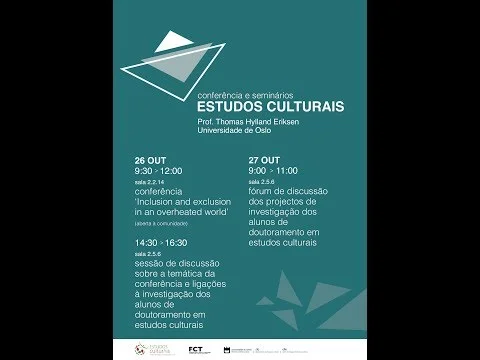
In the contemporary world, change has accelerated only in the last 25 years: Anything from coal exports to international trade and the number of photos taken annually has grown almost exponentially since the end ot the Cold War. I call this process overheatingh: it is a runaway growth process without a thermostat or regulator. What are the implications of this accelerated growth for belonging, identification and modes of inclusion and exclusion in complex societies? Generating heat creates frictions – which are the main frictions in contemporary societies, how have they emerged, and how can they best be understood? The lecture will take on familiar examples such as Brexit, the so-called refugee crisis and the election of the Twitter president, but it will also look for global patterns by hinting at similar overheating effects elsewhere in the world.
«Thomas Hylland Eriksen og historien om Origamijenta» er en 50 minutter lang norsk film, regissert av Dag Johan Haugerud («Som du ser meg»).
Filmens forteller sliter for å lage en politisk film, men blir mer og mer opptatt av origamijenta som i sin jakt på mening oppdager at hun har et eksepsjonelt talent for papirbretting -- alt mens Thomas Hylland Eriksen forsøker å forklare hvordan markedsliberalismen har inntatt underbevisstheten vår.
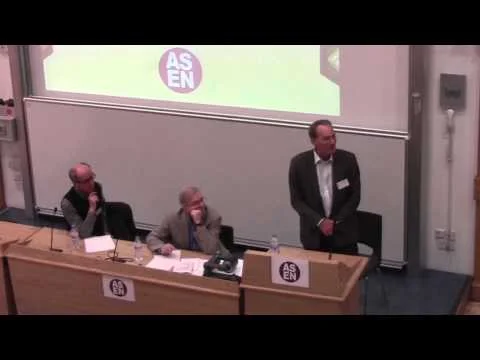
"Grammars of inclusion and exclusion: options for 21st century nations"
Given by Gregory Jusdanis Thomas Hylland Eriksen (http://folk.uio.no/geirthe/), Professor of Social Anthropology at the University of Oslo.
Plenary 1 at the 2014 ASEN Conference on Nationalism and Belonging
For more information, please visit http://www.lse.ac.uk/ASEN
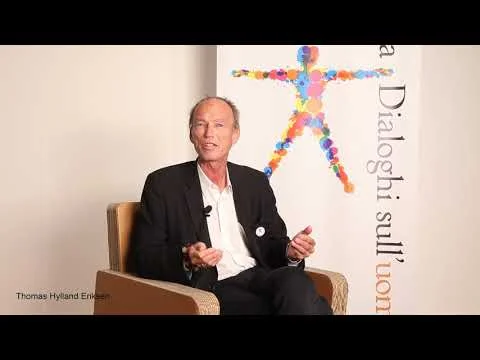
Thomas Hylland Eriksen intervistato a Pistoia Dialoghi sull'uomo 2018 su tema: chi ha saputo rompere le regole
Australian Anthropological Society Conference 2012, hosted by the University of Queensland.
Keynote address: 'The three crises of globalisation and the role of Anthropology'
Presented by Thomas Hylland Eriksen, University of Oslo.
26 September 2012
Thomas Hylland Eriksen is an anthropologist and writer based at the Department of Social Anthropology, University of Oslo, Norway. His fields of research include identity, nationalism, globalisation and identity politics.
The world is overheated – and we arent just referring to climate change. Its too full, too fast and developments are uneven and unequal. Everything takes place .
In this short video Prof. Thomas Hylland Eriksen outlines the concept of overheating, at the core of his new book for Pluto Press, published June 2016. To find .
Talk by Thomas Hylland Eriksen in the Futures Lecture Series with the title: Overheating: Coming to terms with accelerated change A rapidly changing world .
Prof. Thomas Hylland Eriksen (University of Oslo) Wykład An overheated world: The anthropology of global crisis wygłoszony 7 października 2013 roku w .
Thomas Hylland Eriksen er forsker i prosjekt WAIT. Her forklarer han hvilke problemstillinger prosjektet belyser, og hvordan tid og venting blir forstått og behandlet.
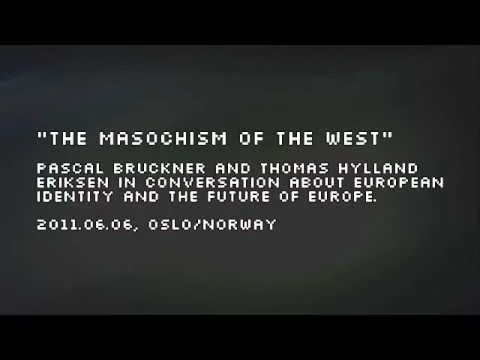
The masochism of the West: Pascal Bruckner and Thomas Hylland Eriksen in conversation about european identity and the future of europe
Litteraturhuset, Oslo, 2011.06.06
Prof. Thomas Hylland Eriksen (University of Oslo) Wykład "An overheated world: The anthropology of global crisis" wygłoszony 7 października 2013 roku w Instytucie Etnologii i Antropologii Kulturowej UJ.
Thomas Hylland Eriksen is among the most distinguished anthropologists of our times. He is currently Professor of social anthropology at the University of Oslo, and leads the Overheating project funded by the European Research Council. A prolific writer, he has authored many books and has contributed considerably to popularising social anthropology through his work. He writes and talks in many genres about the contemporary world, what it means to be human and how the world can be made a better place. When not teaching, writing, or speaking around the world, you can find him absorbed in people watching in Trinidad or Mauritius.
Læreverket FOLK dekker faget sosiologi og sosialantropologi innen programfaget politikk, individ og samfunn.
“Jeg kom på at det var noe jeg måtte huske da mobilalarmen pep ti på syv, og mens jeg barberte meg innså jeg at det dreide seg om lettmelk. Etter at barna flyttet hjemmefra er de daglige innkjøpene blitt mer usystematiske, og i går droppet jeg supermarkedet og kjøpte bare et brød hos bakeren.”
Yes, the pandemic has led to uncertainty, anxiety, suffering and deepened misery for many of the world’s poor. Yet, we may still insist that the glass is half full. This is in fact a golden opportunity for those who seriously wish to deal with the crises of the environment and climate.
Det er på tide å legge kapitalismen bak seg, om ikke av de samme grunnene som Marx og hans tilhengere gikk inn for. Men problemet er stadig at kapitalismen vet hva alt koster, men ikke hva noe er verdt.
A university is not a car factory. And our students are not components to be assembled and processed on a production line in the most technocratically efficient manner without a thought for the culture or working environment in which they learn and develop.
Taking a few steps back, I used the invitation to write an essay about anthropology in Norway as a pretext for delving slightly more deeply into the beginnings – from Eilert Sundt to Gutorm Gjessing – than what is usual.
Episode 5. Psykologen Ole Jacob Madsen snakker blant annet om “digital detox”, selvhjelpslitteraturen som skal hjelpe oss bort fra digital avhengighet og hvordan våre sosiale relasjoner og selvfølelse blir påvirket av smarttelefonen. Han er ikke uenig i at det er grunner til å være bekymret, men det er også mye å være ubekymret og positiv til.
Episode 4. In this episode, two perspectives on the sustainable city are presented by the barista and coffee importer Tim Wendelboe and the green, urban farmer Magnus Humle. Joining in the discussion about global justice, environmental responsibility and options for the 21st century city are the anthropologist Martin Demant Frederiksen and Thomas.
Episode 3. Avstanden mellom elfenbenstårnet og verden utenfor har krympet de siste årene, ikke minst takket være teknologiske endringer. Ståle Wig, Henrik Svensen og Norith Eckbo snakker med Thomas om hva som er god forskningsformidling og hvordan den kan oppnås.
Episode 2. Ida Aalen har skrevet bøker om sosiale medier, og skriver og snakker om dem i mange sammenhenger. Her snakker hun med Thomas om betydningen av å være bevisst på hvordan algoritmene fungerer, hvordan vi kan bli manipulert, om det kan tenkes å regulere de sosiale mediene for å unngå bivirkninger — og hvorfor det er viktig ikke å havne i en skyttergrav.
Episode 12. Professor Richard Ling, a leading researcher and theorist of the mobile phone, speaks with Thomas about the smartphone, ranging from the recent proliferation of smartphones in Myanmar, refugees from North Korea and shopping lists to micro-coordination, six degrees of separation (or less) and the emergence of global villages or dispersed Gemeinschaften.
Episode 11. Samfunnsviteren Einar Flydal, som i episode 10 forklarte sammenhengen mellom overgangen til nettverksøkonomi, privatisering og smarttelefonens verdensherredømme, tar i denne episoden opp et enda mer omstridt tema, nemlig de potensielle skadevirkningene av elektromagnetisk stråling fra trådløse nettverk.
Episode 10. Einar Flydal, som kjenner telekom-industrien fra innsiden, forklarer hvordan fiberoptikk, satellitter og trådløshet er et produkt av nettverksøkonomien, og hva smarttelefonens dominans i våre liv har å gjøre med dette.
Episode 9. Forfatteren og kommentatoren Torgrim Eggen ble tiltrukket av smarttelefonen fordi han har telefonskrekk. For ham er den først og fremst et medium for skriving og lesing, men også han opplever flimmer og fragmentering som resultat av det nye mediet. Her snakker han med Thomas bl.a. om papir og skjerm, Axel Jensen og skriftkulturens fremtid, den ideologiske polariseringen på Facebook og andre tveeggede sverd i smarttelefonens tidsalder.
Episode 8. Ståle Wig snakker med Thomas om å sette mobilen på svart/hvitt, konsentrasjonsvansker og hva som skjer på Cuba.
Episode 7. Henrik Sinding-Larsen setter smarttelefonen i en bredere kulturhistorisk sammenheng, og viser hvordan den er siste skudd på stammen i en lang utvikling som begynte med språket.
Episode 6. Forfatteren John Erik Riley snakker med Thomas om grensene mellom overvåkning og frigjøring, stillhet og tilgjengelighet, hva smarttelefonen gjør med vår evne til å lese bilder og sin siste bok, “Øynene i ørkenen”.
Episode 5. Medieprofessor Espen Ytreberg snakker med Thomas blant annet om fellesskap og fragmentering i smarttelefonens tid.
Episode 4. Det er viktig å kunne kjede seg, sier Maria Kartveit, som selv er en avansert bruker av smarttelefoner og annen ny teknologi, men også i stand til å legge dingsen fra seg en hel arbeidsdag. Hun deler sine tanker blant annet om personovervåkning, fine apper, personlig ansvar, papirbøker og – altså – kjedsomhet.
Episode 3. Peter Normann Waage: Det er blitt lettere å oversette, men vanskeligere å huske telefonnumre.